


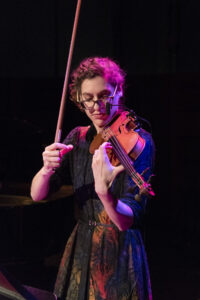
Emily Graber is an interdisciplinary sound artist in Washington, DC. Her creative practice explores embodied cognition and aesthetic appreciation in music through performance, musical interface design, composition, and perceptual studies. Graber’s creative work often features simultaneous expressions of gesture and sound, and interpretations of data and symbols in music. Graber has shown works at IRCAM, Banff, Stanford, Purdue, Lisbon, Oslo, and Allegheny College’s Galleries.
From 2023 to 2025, Emily was an Assistant Professor at Allegheny College in the Department of Computer and Information Science teaching music technology, data science, and programming.
From 2021 to 2023 Emily was a Marie Skłodowska-Curie Fellow at the Institut de Recherche et Coordination Acoustique/Musique (IRCAM) in Paris, France. Her project, EAR Stretch, focused on augmenting listener enjoyment of contemporary classical music through embodied interactions with conductor control interfaces. EAR Stretch was hosted by the Centre national de la recherche scientifique (CNRS) at the lab for Science and Technology of Music and Sounds (STMS), and supervised by Elaine Chew.
Emily lived in Toronto, Ontario, from 2019 to 2020 and investigated music therapy strategies for hearing rehabilitation as a postdoctoral researcher at the Sunnybrook Research Institute. Emily also performed chamber works with the University of Toronto Contemporary Music Ensemble. She was the assistant concertmaster for Hart House Orchestra and principal violist for the University of Toronto Philharmonic Orchestra.
Emily started playing violin at age 7. She was a soloist with the Syracuse Symphony Orchestra at age 15. Emily went on to study violin at the University of Michigan with Yehonatan Berick, where she received a BMA in violin performance and a BS in interdisciplinary physics. Emily earned a PhD from the Center for Computer Research in Music and Acoustics (CCRMA) at Stanford University in the field of music technology. Her doctoral research used neuroimaging to study how performers and listeners anticipate and experience musical tempo changes.
Emily makes music and sound installations which have been shown at The Square DC, IRCAM, University of Oslo, ACM Multimedia, Banff, Stanford’s Center for Computer Research in Music and Acoustics, and featured in collaborative films and dance recitals at the University of Michigan. Emily has attended festivals including Banff Concert in 21st Century, soundSCAPE, Bowdoin International Music Festival and the St. Lawrence String Quartet Seminar.